The manufacturing of electronic circuits for advanced security systems must prioritise reliability, process repeatability, traceability…
From prototype to first production run what to validate before manufacturing
The prototype works on the development bench, but the first production run raises different questions. Can assembly be repeated using the available documentation? Are materials and tests defined? Who approves a change if a supply issue arises? Moving from development to production means resolving these decisions.
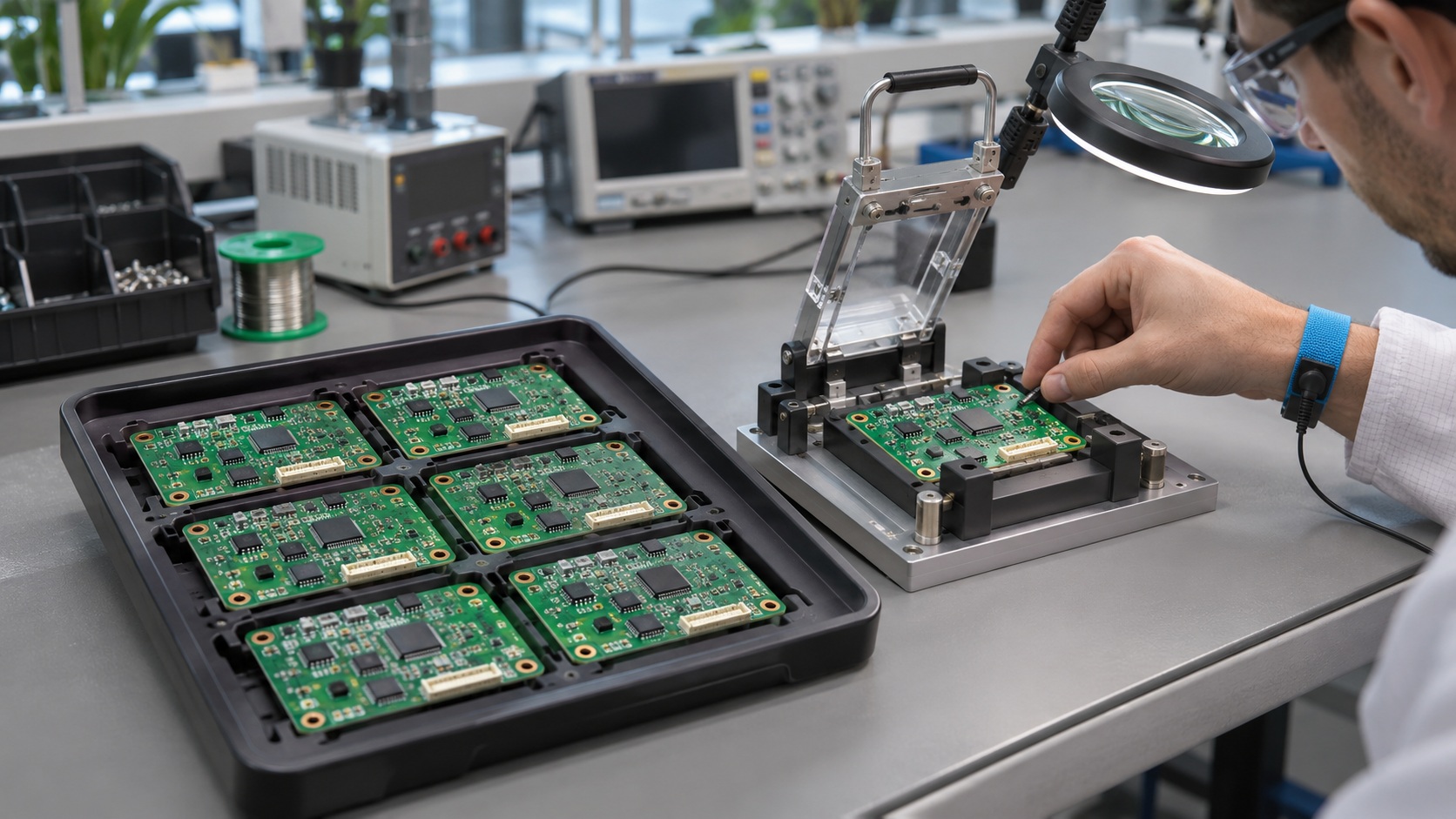
Validation of an initial electronics production run must connect product performance with the ability to manufacture it under controlled conditions. A pilot batch can assess aspects of the process before scaling up, provided its objectives and acceptance criteria are defined. Making a few units without a review plan provides less information than it may appear to.
Agree what the pilot batch must demonstrate
Before starting, define the questions to be answered. You may need to check the assembly sequence, access for a test or integration of the board into its enclosure. Distinguish design considerations from process considerations so that the results can be interpreted appropriately.
Establish acceptance criteria at the outset
State what constitutes a conforming result and how it will be recorded. If a test requires a fixture, program or specific configuration, it must be available and approved. Do not wait until assembly is complete to decide what should have been measured, or accept a deviation without assessing its consequences.
The number of units and the representativeness of the pilot depend on the product, process and applicable requirements. No universal quantity turns a prototype into a validated production series. The project's technical and quality leads must agree that scope.
Release a consistent documentation package
Check that the schematic, bill of materials, manufacturing files and drawings refer to the same revision. Include the necessary programming, assembly and test instructions. If variants exist, identify the configuration to be built and which positions or elements differ.
Documentation should make it possible to work without continually relying on the memory of the person who built the prototype. Informal notes may help during development, but any condition needed to repeat the result belongs in the released package. Identify who is authorised to resolve questions and approve modifications.
Review materials and availability
The prototype may have used components available in small quantities that do not suit the planned supply arrangement. Review part numbers, approved alternatives and materials provided by each party. Commercial availability alone does not establish that a substitution is technically suitable.
Keep alternatives under control
When a change is proposed, assess its effect on assembly, operation and testing. Record approval and the affected revision. An alternative used during the pilot should not enter series production merely because it allowed several units to be completed: its subsequent use needs a documented decision.
Mechanical parts, connectors, wiring and fasteners also require review. A board may work independently yet present problems when integrated into the complete assembly. The validation scope must reflect the product that will actually be supplied.
Check the assembly process
Observe the sequence of operations and identify recurring difficulties. There may be components with limited access, ambiguous instructions or steps dependent on undocumented manual adjustments. Recording these issues helps establish whether the design, fixture or work instruction requires improvement.
Not every difference observed requires a product modification. Some relate to preparation or method. Joint review helps assign causes and avoid changes that address a symptom without resolving its origin. If an important condition changes, assess which parts of validation need to be repeated.
For example, an assembly difficulty may result from the order in which two parts are fitted rather than from either part's geometry. Recording the sequence and the point at which access becomes restricted gives the team evidence to review. The solution should be evaluated and incorporated into the controlled instructions, rather than left as informal operator knowledge.
Distinguish inspection from functional testing
Inspection can detect certain assembly defects, but it does not by itself demonstrate that the equipment performs its functions. Functional testing must address defined requirements using a known configuration. The two activities can complement one another, with a clear scope for each.
If firmware is programmed, record its version and configuration. If a response is measured, define conditions and limits. Applicable regulatory and safety requirements must be reviewed by competent professionals; passing a pilot batch does not automatically confer commercial or medical approval.
Close issues before increasing volume
Bring the results together and classify deviations by their impact. Assign owners and confirm which actions must be completed before series release. An exceptionally accepted issue must remain distinct from a conforming characteristic, with the decision recorded under the project's quality system.
Closure should establish a clear baseline for the next batch: approved documentation, materials, process and tests. This allows subsequent production to be compared with a known reference and makes changes traceable if differences emerge later.
Frequently asked questions
How many units should the first production batch contain?
There is no universal figure. Agree the batch size based on risks, process variability and the planned checks.
Should the firmware version be fixed before the pilot batch?
Yes, when it forms part of the product. Identify version and configuration so each result relates to the equipment actually tested.
Does passing the pilot batch complete product validation?
No. It demonstrates only the criteria checked in that batch. Review outstanding tests and requirements separately before releasing production.
Prepare industrialisation with Electrolomas
Electrolomas offers prototyping, industrialisation and manufacturing services. If your project is ready to move into an initial production run, share the design status, planned quantities and tests already performed.
The next step is to agree what remains to be checked and how it will be documented. A properly planned pilot helps the team learn about both the product and its manufacture before increasing volume, while keeping technical decisions under control.
Related Posts