The manufacturing of electronic circuits for advanced security systems must prioritise reliability, process repeatability, traceability…
SMD with AOI in Electronic Manufacturing: Automated Inspection and Improved Reliability in the Medical IoT
SMD with AOI in electronic manufacturing helps reduce errors. In mass production, minimizing defects is essential. This not only guarantees a high-quality final product but also reduces economic losses and other costs.
SMD Assembly with AOI in Electronic Manufacturing: Advanced Electronic Production Lines
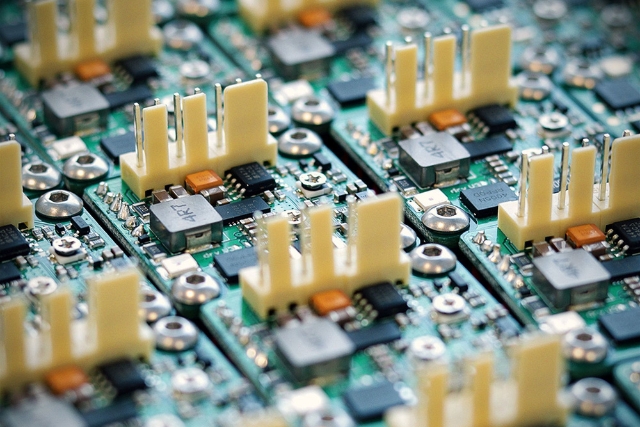
Surface mount device (SMD) assembly is currently the most widely used standard. This is due to its main advantage: the ability to integrate a large number of components onto small surfaces. Furthermore, very tight positional tolerances are achieved, falling below 25 micrometers.
By incorporating AOI (automated optical inspection) systems, quality control is transformed, becoming continuous and non-invasive. High-resolution cameras and machine vision algorithms are used to analyze each board after reflow soldering, allowing the result to be compared to a reference standard. In this way, common defects, such as solder bridges, displaced or missing components, and insufficient paste levels, are detected in seconds.
Due to its advantages, the impact on the defect rate is significant. Implementing AOI on SMD lines reduces missed defects by almost 90%, a substantial improvement. Thus, in mass production, this difference equates to millions of conforming units that would otherwise have to be rejected or reworked.
Furthermore, the AOI system provides much-needed traceability. Each inspection is recorded with data associated with the batch, shift, and soldering equipment. This information allows for the quick and easy identification of root causes and the application of preventative adjustments before the problem escalates.
Reliability of the Medical IoT Thanks to Advanced Electronic Quality Control
A medical IoT device operates in environments where the margin for error is zero. A heart rate monitor, a continuous glucose sensor, or a hospital telemetry device transmits clinical data that influences medical decisions. If its reliability is not high, a patient’s health could be at risk.
To ensure proper functioning, advanced electronic quality control is performed, combining several application layers. X-ray inspections are carried out to detect internal defects in BGA and QFN packages that AOI cannot reach. In-system circuit testing (ICT) verifies the electrical integrity of each node, and functional validation subjects the device to its actual operating conditions before batch release.
Furthermore, it is important to consider that the medical sector is regulated by strict regulations, such as the European Medical Devices Regulation (MDR 2017/745), which requires comprehensive technical documentation and complete traceability of each unit. Applying this ensures that manufacturing processes do not lack structured quality control.
In short, SMD assembly with AOI in electronic manufacturing guarantees the quality of IoT devices in medicine. At Electrolomas, we integrate these processes into every production line to guarantee components and devices that meet the most demanding market standards.
Related Posts